
Newport News City Directory Holdings
Newport News Public Library holds the historical city directories for the area through the Martha Woodroof Hiden Memorial Room. Library materials describe Newport News editions running from 1898 to the present. The library publishes no complete annual run. That gap matters for researchers. A catalog entry is only a lead to an edition. It is never proof that every year sits on a shelf or online. Before treating any directory entry as evidence, confirm the edition title. Also confirm the year, page, and locality heading as printed.
| Collection | Years | Where Held | Access |
|---|---|---|---|
| Newport News city directories | 1898 to present, as described by library materials | Newport News Public Library and Hiden Virginiana Room | Confirm the edition and any gaps with the room or catalog |
| J.L. Hill catalog examples | 1897 to 1898; 1927 example | FamilySearch catalog and physical-film catalog records | Regional title and locality heading need checking |
| UVA Race and Place listings | 1898 to 1919 | University of Virginia digital humanities database | Online name, occupation, and year search |
| Daily Press obituary index | 1898 to 1988; Times-Herald 1902 to 1915 | Newport News Public Library linked index | Index lead, then obtain the newspaper page |
| School yearbook archive | 1912 to 2000 | Library-linked collection | More than 200 school-year snapshots |
The earliest cataloged J.L. Hill edition groups Newport News with Hampton, Phoebus, and Old Point. A 1927 Hill directory also folds in Hilton Village. Titles like these double as historical geography. Still, a regional label does not mean every printed entry falls within today's Newport News boundary.
Newport News Directory Room Access
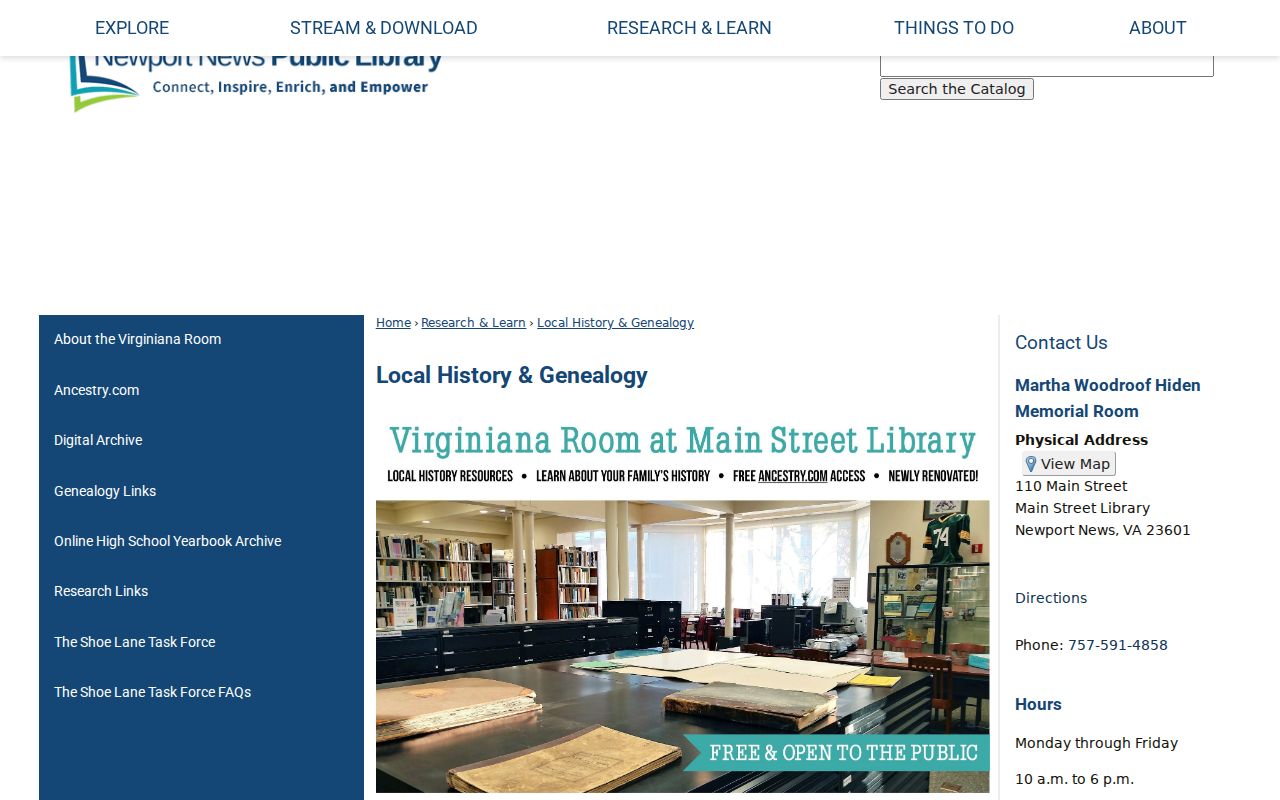
The Hiden Virginiana Room at Main Street Library anchors local research in Newport News. Its shelves hold city directories, obituary indexes, newspapers, maps, manuscripts, and vital-record microfilm. The room sits at 110 Main Street, Newport News, Virginia 23601, and the listed phone is 757-591-4858. Hours run Monday through Friday, 10:00 a.m. to 6:00 p.m. Saturday visits need an appointment set 72 hours ahead, and the room stays closed Sunday. Come prepared with a name, an address, a date range, and any old locality label.
Frame each request around one exact item: a directory edition, an obituary-index range, a map, or a microfilm series. Staff know the collection well. They can flag an edition gap, point to the right Newport News newspaper title, or decode a Warwick-era label that a broad database search tends to miss. Note the title, repository, call number when one exists, the page, and the printed locality. That trail lets another family researcher retrace every step.
The Newport News Public Library local-history page documents the room and its research materials.
Remember that the room itself, its catalog, and its card-dependent resources may each open a different route to a historical entry.
Newport News Digital Directory Collections
Bound directories are only the start. The Newport News Digital Collections platform broadens the shelf with books, manuscripts, maps, periodicals, photographs, and microfilm, plus transcribed birth and death records covering 1896 through 1912. Searchable metadata helps a resident lookup land on a promising document or image fast. Even so, the title, date, rights statement, and source line tell you whether an item truly answers the question. Read each digitized object in its own historical context. The Newport News Digital Collections landing page is the direct source for the online collection.
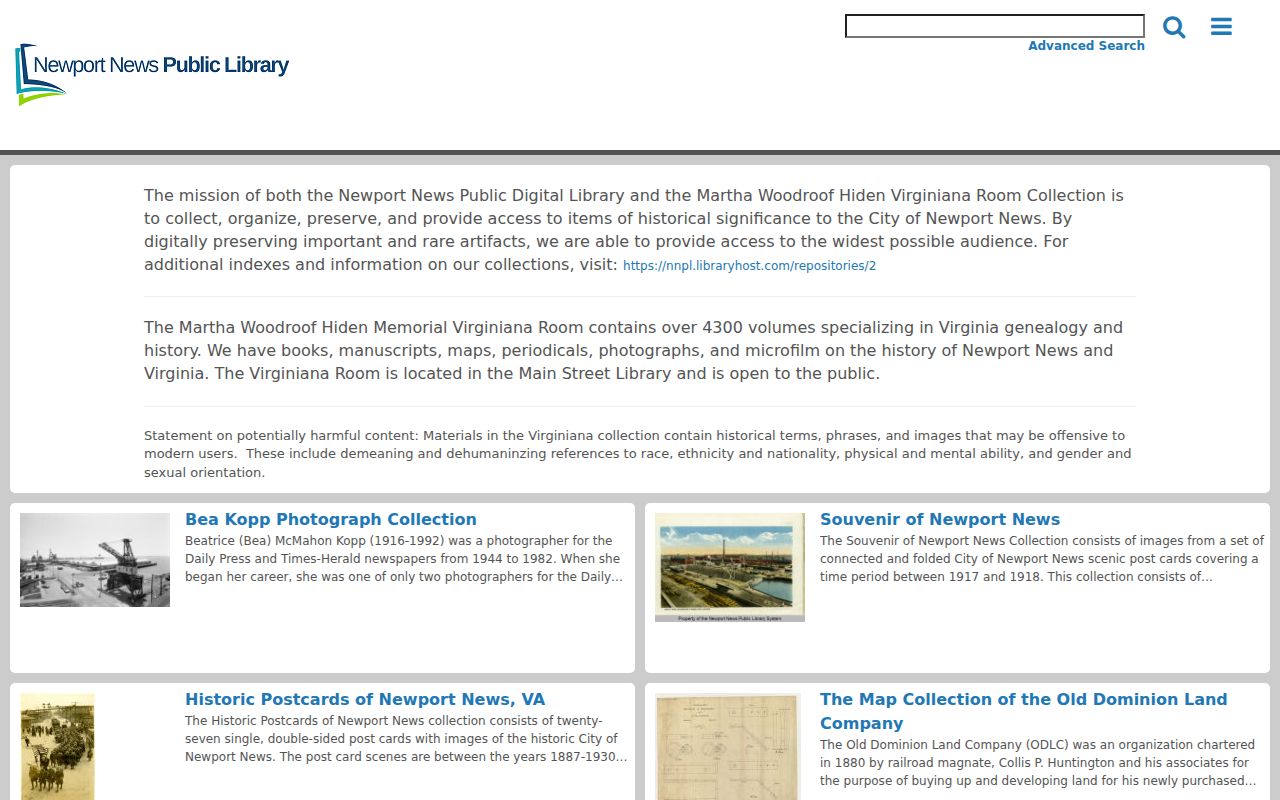
Digital metadata can carry you from an address or surname to a dated map or photograph. It can also lead you to a manuscript or vital-record transcription. It does not create a current-person claim. The library collection page describes more than 4,300 Hiden-room volumes. Digital access is a real gain. Yet it does not put every directory edition online. Some newspaper pages stay behind a library-card or copyright restriction.
How Newport News Directory Entries Read
Treat an entry as a dated printed record, not a modern profile. A Newport News city directory entry may print a name, street address, occupation or business, spouse, household or boarding notation, telephone, employer or business address, edition year, page, abbreviations, neighboring entries, and the street section. No volume shows every element. Copy exactly what is printed, initials and abbreviations included. Guessing at an expanded term only corrupts the record.
| Printed name | Keep initials, spelling, suffixes, and the form used in that edition. |
|---|---|
| Address | Record the street number and name, plus whether it appears in a name or street section. |
| Occupation or business | Treat it as a period clue that may help distinguish namesakes. |
| Household notation | Copy spouse, boarding, or other language only when the volume prints it. |
| Edition details | Keep the year, page, locality heading, abbreviation key, and nearby entries. |
- Criss-cross directory
- An address-ordered directory section, if a specific edition includes one, that can help locate entries by street rather than name.
- Householder index
- An index that groups a household or address reference; its contents and coverage depend on the individual volume.
- Abbreviation key
- The volume’s explanation of its shortened terms. Read and preserve it before interpreting a line.
Newport News Directory Name Search
The UVA Race and Place city-directory database offers a distinct Newport News resource. It covers 1898 through 1919. Its search fields are First Name, Last Name, Occupation, and Year. For African American history the collection is especially valuable. It adds another path through an era when one surname appeared in many printed forms.
Treat each result as a source-specific lead. Match the year against the directory, obituary index, newspaper, or yearbook where appropriate. Do the same for the printed form. Never assume a match delivers a full household, a current location, or property ownership. Names recur across decades. The original record's date governs what it can establish.
Note: Ask the Hiden Room and historical-society holdings about any specific criss-cross edition. Official reverse-directory titles and coverage years remain unpublished.
Tracing Newport News Directory Households
Start family-history work with the directory nearest a known event. Keep the historical locality visible throughout. Search the name, then read the full street section. A surrounding line may expose a boarding house, institution, or business. It can also reveal a neighboring household that a name-only result hides. Work one edition at a time. Note first appearance, disappearance, spelling changes, household language, and address moves.
- Write the printed address, year, page, name form, and locality label from the first useful directory entry.
- Check the edition before and after it, keeping each result separate rather than merging dates.
- Read the street section and surrounding entries for the same year when the volume provides one.
- Pair the directory sequence with census years, then compare an obituary, yearbook, newspaper, or vital-index lead.
- Use a deed or parcel record only after the historical address and locality have been reconciled.
A name that drops out of a directory can mean many things. A move, a death, or a spelling variant will do it. Lodging that went unlisted, a changed street number, or a missing edition can produce the same gap, so no single cause can be proven from silence alone. When a dated directory clue calls for a modern official check, the Newport News resident lookup provides a separate, current-record workflow.
Newport News Directory Warwick Labels
Label changes complicate older Newport News research. The city was chartered in 1896. North End and East End grew as early suburbs inside neighboring Warwick County. Warwick then existed as an independent city from 1952 to 1958. That came just before the present consolidation took hold. Old directory, land, and court material may therefore carry three different labels. Record the label exactly as the source printed it. Note the event date, and add a modern crosswalk in your research note.
The Library of Virginia catalog covers Newport News records. It also covers Warwick County records from 1646 through 1971. Court, deed, will, tax, election, fiduciary, military, and property series all appear there. Much early material is incomplete, damaged, or fragmentary. The catalog says so plainly. Lost Records Localities digitization may close some of those gaps. Even so, an empty online search never proves a person or place was absent.
Newport News Directory Cross-Checks
Newport News newspapers and school records can test a dated directory trail. The Daily Press has been the local paper since 1898. The library's obituary index spans 1898 through 1988. Its Times-Herald run covers 1902 through 1915. An index entry gives a name, date, and newspaper. It is not the obituary itself. Pull the newspaper page and cite it separately.
Yearbooks offer a second check. More than 200 Newport News high-school yearbooks survive, dated 1912 through 2000. They preserve names, activities, photographs, and addresses exactly as printed at the time. That makes them strong historical context. A yearbook or obituary still cannot establish where a person lives now.
Hilton Village Directory Snapshots
Hilton Village makes a good Newport News example. It was built during World War I for shipyard workers supporting wartime production. The 1927 Hill directory title even lists Hilton Village alongside Newport News and nearby localities. Wartime migration, military camps, port traffic, and shipyard growth could put temporary lodgers or boarders in a directory. The deed names none of them.
That contrast is exactly why a house history needs more than one record type. Directories and newspapers can reveal a short-lived address connection. Deeds, meanwhile, establish the legal chain of transfer. For present-day parcel and address facts, rely on the Newport News street directory. Do not treat a historical volume as a current roll.