
Newport News Previous Resident Sources
A backward address trail begins with the kind of history sought. Current assessor data connects a street address to a parcel ID. The Circuit Court Clerk’s land-record route can connect legal parties and recorded instruments. Dated Newport News directories, maps, obituaries, and archival records add household and neighborhood context. None of those sources is a complete roster. Together, they let a researcher separate a legal property chain from evidence about who lived at an address at a particular time.
| Source | Years It Covers | Where Held | What It Shows |
|---|---|---|---|
| Circuit Clerk remote land page | January 1, 1896 to present, as stated | Newport News Circuit Court Clerk | Grantor/grantee index and land-record images, subject to access rules |
| Clerk subscriber agreement deed statement | October 1865 to present, as stated | Newport News Circuit Court Clerk | Earlier deed-index claim that needs confirmation |
| Special Index | Before July 1, 1982 | Circuit Court Clerk | Older name and index route |
| Newport News directories | 1898 to present, described by library materials | Hiden Room and library | Dated name, address, and occupation snapshots |
| Sanborn and city engineer maps | February 1897; 1910 | Library of Congress | Building, street, lot, and block context |
| Warwick archival records | 1646 to 1971 catalog span | Library of Virginia and related archives | Older deed, court, tax, property, and local-history context |
The two Clerk statements conflict on the earliest remote coverage. Preserve both dates in the research notes. For an 1865 to 1895 deed question, contact the land-records office and ask which Special Index, physical, or microfilm route applies instead of assuming the web index reaches the record.
Newport News Parcel Record Start
Start an address history with the Newport News Real Estate Assessor, then save the parcel or Tax Map ID and displayed tax year. The assessor separates several concepts that are easy to confuse: the situs address is the mapped property location, the mailing address is where tax correspondence goes, and the parcel ID is the crosswalk to GIS and deeds. A current assessment owner can be a person, trust, estate, corporation, or public entity. It is a property connection, not proof of who lived there.
The Newport News Property Assessment Search is the direct source for its address, parcel, and owner-name search routes.
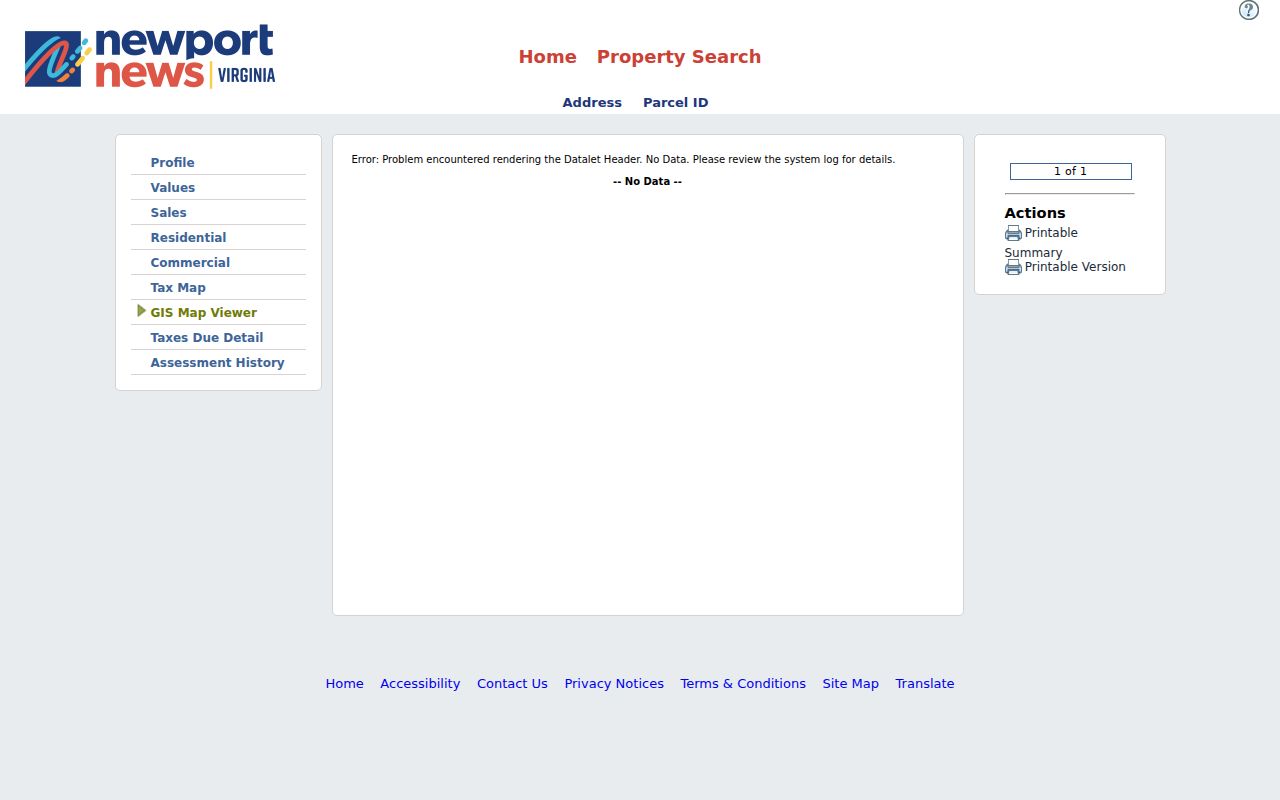
The observed parcel-card layout separates Profile, Values, Sales, Residential, Commercial, Tax Map, GIS Map Viewer, Taxes Due Detail, and Assessment History, which helps preserve the source of each fact.
Use the displayed parcel ID in the GIS Viewer before turning to the deed index. If the address is absent, try a street suffix, historic name, parcel ID, adjacent address, subdivision lot and block, or a Warwick-era locality label. A missing address result is not a finding that the parcel never existed.
Newport News Deed Record Chain
The Newport News Circuit Court Clerk holds deeds, deeds of trust, plats, judgments, financing statements, fiduciary and probate records, marriage records, business records, and other permanently retained judicial records. For address history, use the current parcel ID, GIS or Tax Map bridge, legal description, and current instrument reference to locate the recorded chain. The remote route offers grantor/grantee indexing and land-record images, while actual image access can require a notarized subscriber application and subscription.
The Circuit Clerk remote land-records page is the source for the online route, Special Index, and access information.
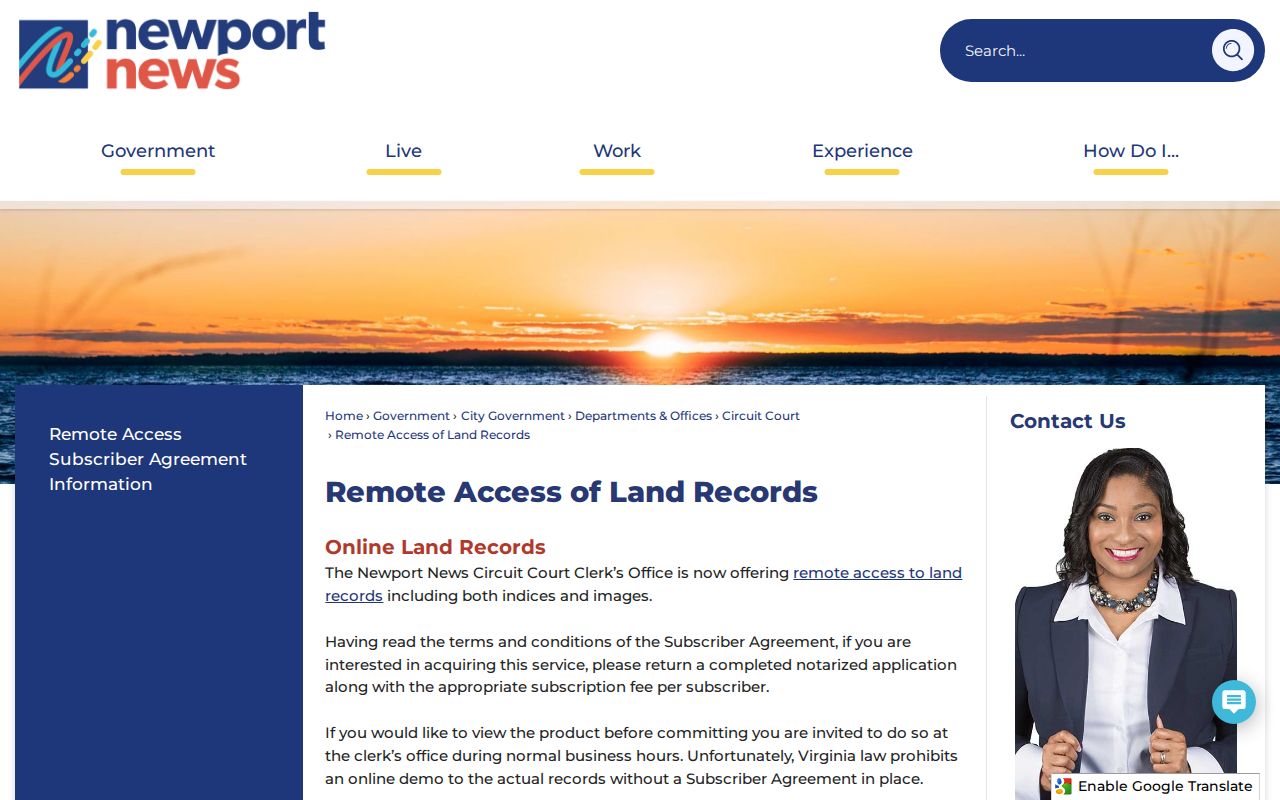
The Clerk page points researchers from an index lead to subscriber, office, or copy-request access when the legal instrument itself is needed.
- Search the assessor with the normalized address and record the parcel ID, situs, tax year, and legal description if shown.
- Use GIS and the Tax Map to confirm the parcel, subdivision, and whether a split, merge, or historic number may affect the match.
- Find the current recorded instrument by grantee, party, legal description, or recording reference, then keep the book and page or instrument number.
- Search that prior legal party in the opposite direction to locate the earlier transfer, keeping recording dates and legal descriptions together.
- Repeat backward, stopping for the Special Index, Clerk office, physical record, microfilm, plat, or archival route when remote coverage no longer answers the question.
- Grantor
- The party transferring an interest in a recorded instrument. It can be a person, estate, trustee, corporation, or other legal party.
- Grantee
- The party receiving an interest in that instrument. A grantee is not automatically an occupant of the property.
- Chain of title
- The sequence of recorded property transfers traced backward through linked instruments and legal descriptions.
- Legal description
- The lot, block, subdivision, metes, or other recorded description that can be more stable than a street number.
Newport News Special Record Index
Older deed work requires a clear access note. The Clerk’s general remote page says land-record images and grantor/grantee indexing begin January 1, 1896. The subscriber agreement says deeds begin October 1865 and warns that a name search does not reach earlier dates. Both statements are official, and neither should be silently substituted for the other. The Special Index is the documented route for records before July 1, 1982.
For material outside the accessible index, use the Circuit Clerk office, a mail copy request, Hiden Room material, and the Library of Virginia catalog. Mail requests require contact information and document details, payment by check or money order to Newport News Circuit Court, and a self-addressed stamped envelope. Ask the Clerk what detail is sufficient for a copy and avoid sending unnecessary sensitive information.
Note: Remote results are index leads. Confirm the actual instrument, access level, and earliest searchable date with the Clerk before making a title-history conclusion.
Newport News Deed Record Preservation
In April 2024, the Newport News Circuit Court Clerk received a $17,100 Library of Virginia CCRP grant to conserve Deed Books 2 through 7, records dated 1896 through 1898. The project also supports digitizing and making those land records public through the online records system. It is a practical example of why a historical search may gain new access over time while still requiring a check of the item’s date and condition.
The official preservation announcement describes the Deed Books 2 through 7 project. It does not mean every older deed is already digitized or complete. The Library of Virginia catalog also warns that some pre-1866 Newport News and Warwick material is damaged, incomplete, or fragmentary.
Lost Records Localities digitization may supply an alternate route for an early gap. Search the archival catalog, preserve the source’s locality label, and write down the exact record series checked. A documented gap is more useful than a confident guess about a missing household.
Newport News Historic Address Records
Historic maps can bridge an address before a modern parcel number existed. The February 1897 Newport News Sanborn collection has 20 sheets. Its graphic and key map helps locate a street across the full set, and the sheets can show building footprints, use, construction materials, and fire walls. They do not identify occupants. The 1910 city engineer map adds lot and block numbers that can be paired with a deed book, recorded plat, and current parcel geometry.
The Newport News Digital Collections landing page is a local route to digitized maps, books, photographs, manuscripts, and periodicals.
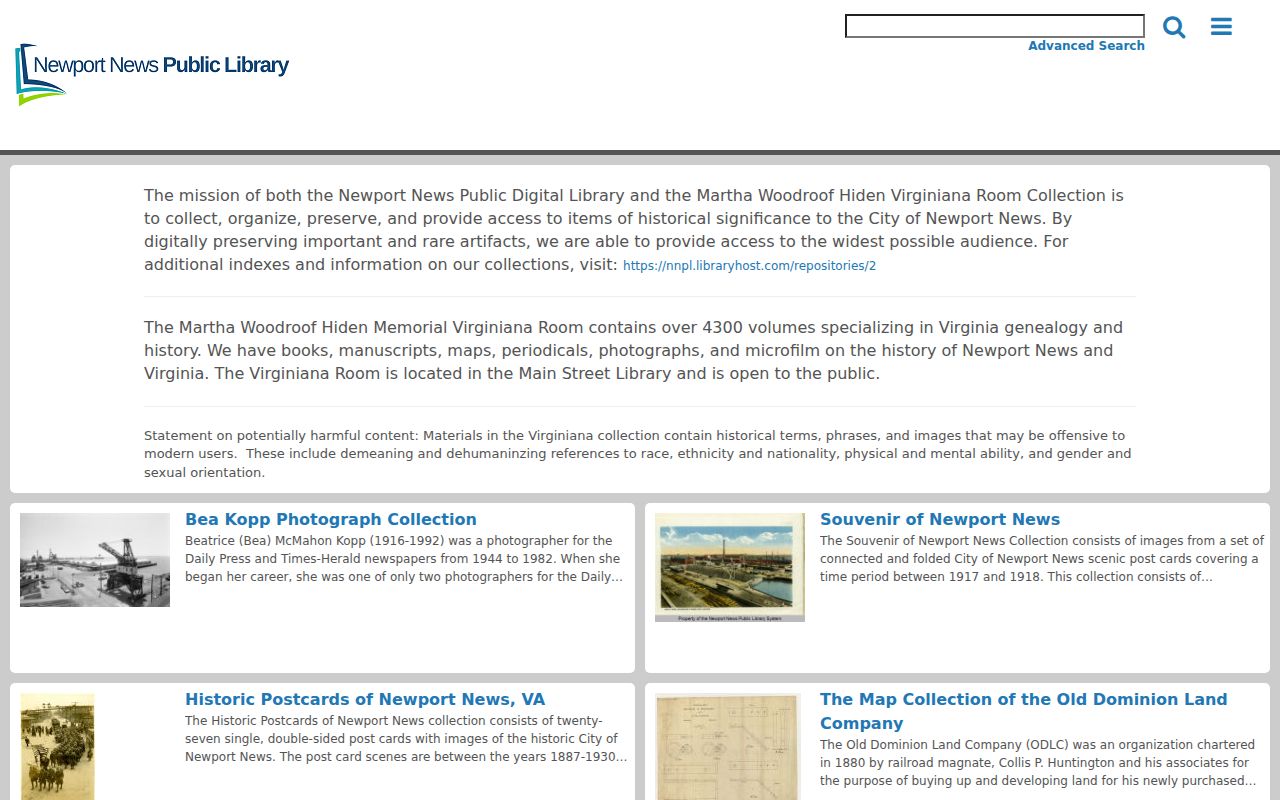
Digital-collection metadata provides a date and source trail for a map or local record, while the original object supplies the context needed to read it carefully.
A map and a directory serve different purposes. Use the map to locate a street, lot, block, or building context; use the dated directory to test a printed address; use a deed or plat for the legal property link. Do not turn a map footprint into a claim about a named resident.
Newport News Past Household Records
A deed chain and a household trail are not the same thing. Past residents can appear in a Newport News city directory as a dated address, occupation, business, spouse, or boarding reference even when the deed names a trustee, lender, estate, or corporate party. Start at the Hiden Room with the nearest directory edition, preserve the printed name and street form, and read the full street section when possible. The collections themselves are described on the Newport News Directory Book.
The Newport News Public Library local-history page is the source for Hiden Room holdings, obituary work, newspapers, maps, and microfilm.
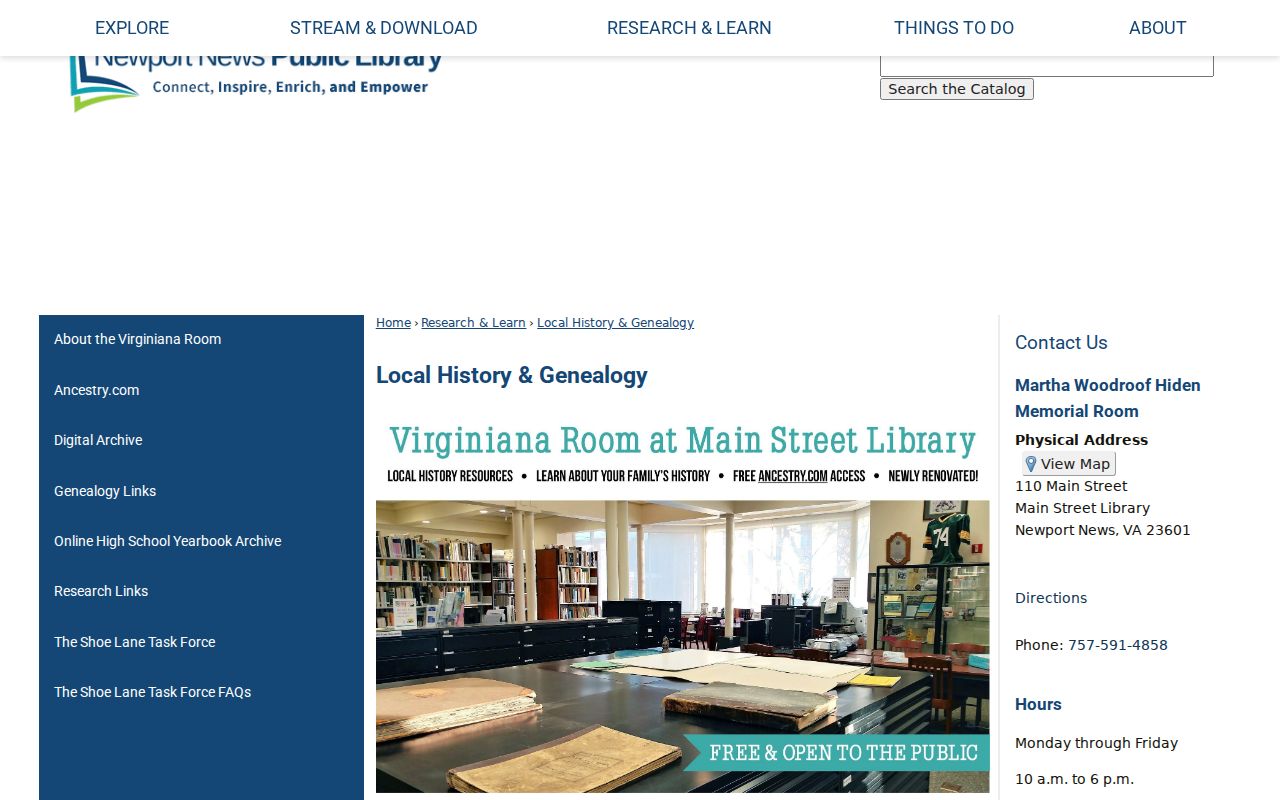
The research room gives an in-person route when an edition, newspaper page, microfilm item, or finding aid is not available through a public web interface.
- Match an address and locality label to the directory edition nearest the event being researched.
- Move forward or back one edition at a time, noting first appearance, disappearance, spelling, household language, and address change.
- Pair the dated directory sequence with census years and then test a newspaper, obituary-index, yearbook, or vital-record lead separately.
- Reconnect the historical street form to the parcel and deed chain only after a map, plat, or official index supports the crosswalk.
Newport News Warwick Record Labels
Newport News was chartered in 1896, and older records can fall under Newport News, Warwick County, or Warwick city. North End and East End developed as early suburbs in adjacent Warwick County. Warwick city existed from 1952 through 1958, when consolidation created the present independent city. The label printed on a deed, directory, map, or archive entry is part of the record. Retain it along with the date rather than replacing it with a modern name.
The Warwick County Historical Society’s scope includes Fort Eustis, Mulberry Island, Morrison, Denbigh, Lee Hall, Blunt Point, and Warwicktown as well as modern Newport News. For an older address, search those locality terms where they fit the period. Nearby localities are not interchangeable with Newport News in a current portal, but they can be essential historical search terms.
Newport News Previous Resident Limits
Historic address research has firm limits. A mailing address may be an agent, post office box, or business address. An assessment owner, grantor, grantee, permit applicant, or person named in an obituary may have a connection to a record without living at the property. A directory entry is a period snapshot, not a certified legal residence record. Record what each source says and avoid combining fields from different dates into one conclusion.
For an unresolved address, keep a short worksheet with the normalized and historic street forms, parcel ID, GIS object, subdivision or plat, deed reference, directory year and page, locality label, source URL, date inspected, and the remaining mismatch. The most useful result may be a clear statement of what was checked and what was not found.